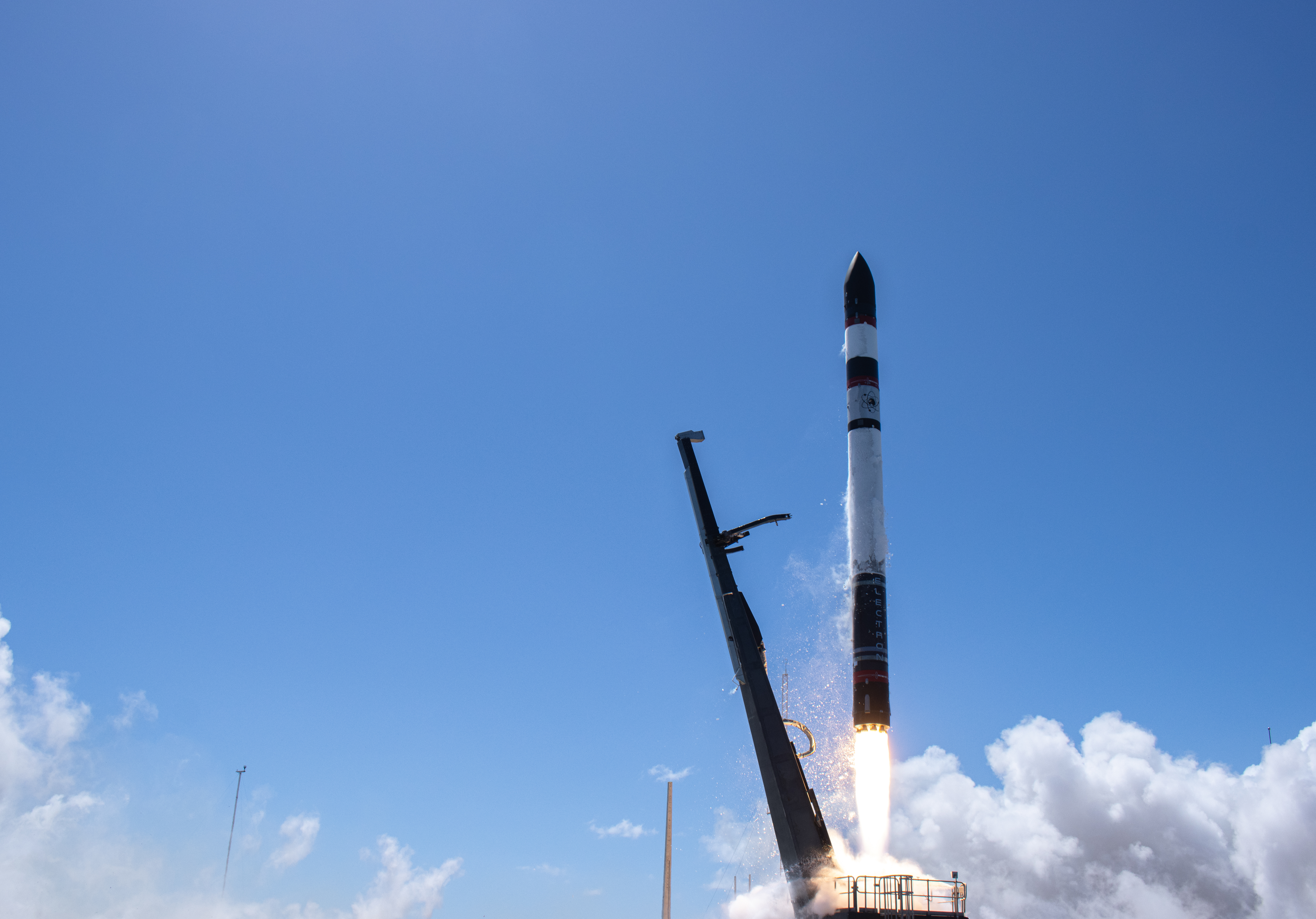
MAHIA, New Zealand–(BUSINESS WIRE)–$RKLB–Rocket Lab (Nasdaq: RKLB), a leading launch and space systems company, has successfully deployed two satellites to orbit for real-time geospatial monitoring company BlackSky (NYSE: BKSY). Rocket Lab also successfully introduced helicopter operations to a recovery mission for the first time, using a helicopter to observe and track the Electron rocket�s first stage as it descended to Earth under parachute as part of the companys program to make Electron the worlds first reusable, orbital-class commercial small rocket.
The Love At First Insight mission, arranged for BlackSky through launch services provider Spaceflight Inc., was Electrons 22nd lift-off from Rocket Lab Launch Complex 1 on New Zealands Mahia Peninsula. Following lift-off at 01:38 UTC, 18 November 2021, Electron successfully delivered the two BlackSky Gen-2 Earth-imaging satellites to a circular 430km orbit, growing BlackSkys constellation of real-time geospatial monitoring spacecraft and bringing the total number of satellites deployed by Rocket Lab to 107.
Todays mission also included a controlled ocean splashdown and recovery of Electrons first stage. For the first time, Rocket Lab stationed a helicopter in the recovery zone around 200 nautical miles offshore to track and observe the descending stage in preparation for future aerial capture attempts. The helicopter successfully tracked the returning rocket and completed communications tests in the recovery zone, bringing Rocket Lab a step closer to catching a rocket from the sky, bringing it back to the production complex for refurbishment, and then launching it to space again.
Peter Beck, Rocket Lab founder and CEO, says: Todays launch was a masterclass from an incredible team of engineers on how to successfully deliver customers satellites to space while at the same time demonstrating cutting-edge operations and innovation that pushes the space industry forward on small rocket reusability. This is our third successful proof of concept recovery mission, and further cements Electron as the leading launch vehicle for the small satellite market. We are all excited to move onto the next phase of reusability next year; catching Electron in the air with a helicopter.
The Love At First Insight mission was the latest launch for BlackSky as part of a multi-launch agreement to deploy numerous BlackSky satellites on Electron. Five BlackSky satellites have now been successfully deployed to low Earth orbit so far on missions across 2019 and this year. As part of the deal, another two BlackSky satellites are scheduled for launch on Rocket Labs next Electron mission named A Data With Destiny, which is scheduled to launch during a 14-day launch window that opens in December. Todays successfully deployed satellites, along with those previously launched to space by Rocket Lab and the remaining four satellites next in line, represent the largest number of satellites BlackSky has dedicated to a single launch provider to date.
+ Images and video content
www.rocketlabusa.com/about-us/updates/link-to-rocket-lab-imagery-and-video/
+ About Rocket Lab
Founded in 2006, Rocket Lab is an end-to-end space company with an established track record of mission success. We deliver reliable launch services, spacecraft components, satellites and other spacecraft and on-orbit management solutions that make it faster, easier and more affordable to access space. Headquartered in Long Beach, California, Rocket Lab designs and manufactures the Electron small orbital launch vehicle and the Photon satellite platform and is developing the Neutron 8-ton payload class launch vehicle. Since its first orbital launch in January 2018, Rocket Labs Electron launch vehicle has become the second most frequently launched U.S. rocket annually and has delivered 105 satellites to orbit for private and public sector organizations, enabling operations in national security, scientific research, space debris mitigation, Earth observation, climate monitoring, and communications. Rocket Labs Photon spacecraft platform has been selected to support NASA missions to the Moon and Mars, as well as the first private commercial mission to Venus. Rocket Lab has three launch pads at two launch sites, including two launch pads at a private orbital launch site located in New Zealand, one of which is currently operational, and a second launch site in Virginia, USA which is expected to become operational by the end of 2021. To learn more, visit www.rocketlabusa.com.
Contacts
+ Rocket Lab Media Contact
Murielle Baker
media@rocketlabusa.com
+64 27 538 9040
Ringing in the New Year, the extended collection promotes moderation and conscious drinking throughout the…
EMEISHAN, CHINA - Media OutReach Newswire - 16 December 2025 - On the evening of…
LONDON, UK - Media OutReach Newswire - 16 December 2025 - Desert diamonds graced the…
SINGAPORE - Media OutReach Newswire - 16 December 2025 - Small and Medium-Sized Accounting Practices…
SYDNEY, AUSTRALIA - Media OutReach Newswire - 16 December 2025 - Leeds Capital and MIO…
Despite 64% reporting revenue growth, 91% of merchants face payment friction HONG KONG SAR -…